Adn school of design is dedicated to exploring unseen realms in art and design, it nurtures and inspires students to think, investigate and envision words and knowledge. Adn enables learners to first observe, then think and explore and finally develop philosophical works of art. The work and knowledge generated at Adn school of design is driven primarily by the study of words and the meanings of literature and by extracting the underlying creative work found within it. Literature; an art form that is far unique and more profound than any other, leaving every small detail to be concluded by the brain, resulting in the physical manifestation of pure imagination. The purity and simplicity of text allows the designer of any artwork to start the process without any former contemplation, by eliminating the reliance on shapes, colors or patterns as sources to design, the result is the pure creation of the brain, separation is in process, creative individuality is born.
The work produced at Adn school of design is driven primarily by the words of Quran, the knowledge and information that the Quran preserves was and still is remarkably influential, it is therefore vital to explore and test that knowledge, the Quran unlike all the other holy books was a source to a prominent architectural era; Islamic Architecture, a physical embodiment of the significant knowledge derived from the book of Quran, thus the students extract and research the message and the words of Quran and in turn apply them into real world projects.
As we can tell two people apart by their faces, identify historical ancestry by DNA and distinguish each physical human presence by fingerprints, here at Adn school of design we attempt to distinguish and extract the individuality of each student by uncovering the identity and nature of their mindset and by tapping into the potential and depths of their thought process.
Learning Process
Designing with Words
Words, whether read, exchanged or newly conceived possess infinite layers of meaning, however we in our passive states of consciousness comprehend the shallow meaning occurring on the very surface, one we discern when we directly associate it with a particular image or experience. In order for us to convert mere word to creation, we must detach from the immediate images that form in the mind when presented with a particular word, we must regard words as ambiguous instruments of creation, the validity of which stem from the varied possible conducts of that particular word and meaning. The deepened perception of meaning is achieved through a process of individual reflection; linking the individual’s collected experience with the meaning in question, through the knowledge formed from the meaning’s logical conduct, the emotions provoked and the nature of memories that emerge. The imaginative potential of the individual dictates the potency of each aspect in the concluding total formation.
Poetry a craft formed by the use of words in a varied construct of meaning, and an associative art that provokes emotion beyond the use of any type of imagery suggests the possibility for it to be a source to concrete creation, to be used as a generative determinant of words. Similarly, the Quran provides us with text formations and meanings that touches us on a spiritual, emotional and logical levels, and instills an individual tendency to contribute in worldly response and action. for this reason, the Quran was chosen to be the source to derive meanings thereon distilled, synthesized and purified to become poetic creations.

Design Birth Process DBP
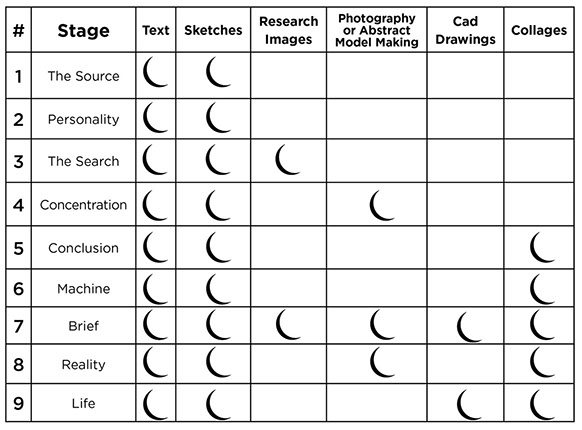
A methodology for creation that yields ingenious final product specifically determined by the individuality of the creator, and the knowledge contained within the book of Quran. The process identifies with litrature as a formative instrument, first used for mind stimulation by the extraction of word composures that resonates with the creator, and correspondingly interprets that resonance into bodies of text narrated by the imaginative potential of the creator. In order to articulate ideas stemming from pure imagination into visible portrayals, the concept must be placed into the context of reality, to form necessary constraints for the rationalization of the idea, this is done by expressing the narrative of the text through sketches and collages, by this stage the process is devoid of external influences, next it shifts from internal investigation to that of externally made perceptions, beginning with a search for works that display similar patterns of thinking and forming a link that connects and defines the idea through an objective stance that serves to lay the groundwork for deciding a topic of creation, moreover, an investigation of surroundings evolves the process into a tangible manifestation by projecting the idea as a response to the influence of the physical realm and conceiving forms that animate both the effect of context and the response issued by the form, the idea becomes an active receptor of the change occurring in space and time.
By this stage the idea becomes a creation that has the potential to influence people physically or mentally, and on that account the creator engages with a process that considers the creation as a form subject to the impact of man, outlining bodily proportions, modes of interaction and the outcome of such correlations, by this point the process is design led forming a topic that touches on the social and moral concerns that the book of Quran carries, as a conclusion the idea and the topic are synthesized into practical application through actual design and art projects.
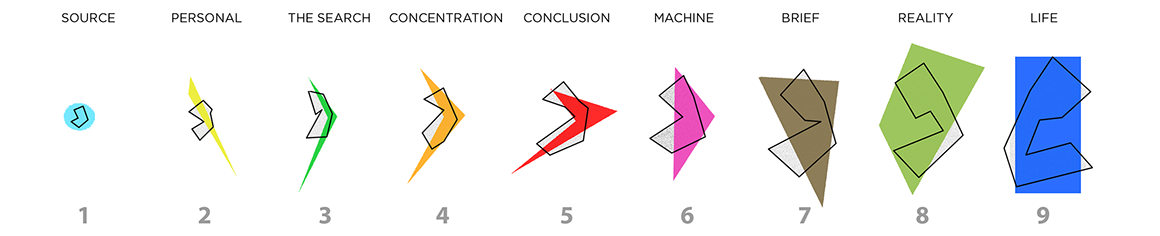
The process begins with the extraction of verses from the holy book of Quran, and continues throughout a course of nine stages, upon the completion of each stage, a design idea further animates within the student’s mind, each stage relates primarily to its precedents, it is a systematic nine step process that accumulates to one objective, a final result, and that is the topic and philosophy that will guide the designer into developing works of art and architecture.
Method The design birth process initiates by selecting verses from the Quran, and progressing into finding official interpretations of the verses and demonstrating each interpretation in quick sketches. Moving into stage two, the students begin to rely on their individual understanding of the verses, this is done by recording personal thoughts on each Quranic verse separately, and next developing a concise description guided by the student's imagination and intellect, explaining it further in sketches, and devising multiple conclusion words that summarize the description and sketch. By this point an initial definition is established, the process next moves into imagery.
The formation of a mental image is the key that prompts the student to begin working on the next stage, thus on the basis of the precede words, a mental image begins to formulate, the visual link of the idea is converted into quick sketches and drawings, and reflected on existing artwork by conducting a search for art, literature and historically acclaimed works. A metaphorical definition of the idea is then extracted from those images, the stage accumulates to its final phase when the student begins to associate it with the surrounding three dimensional world. The next stage is carried out by connecting objects and details seen on the everyday surrounding setting to the idea, linking thought and direct perception and then manipulating that perception to better fit the idea, this is done by employing light, form and material through model making or photography, as means to communicate the philosophy thus conceptualizing the verses into tangible form.
The next concluding stage is an accumulation to the general understanding of the verses and the ideas that will influence the topic for the next stage, this is done through an underlying process that corresponds directly to the way in which man experiences the surrounding environment through connecting human behavior, events and consequence to the derived words, and by finding a relationship between the human experience and the verses of Quran, thus developing a foundation that upon it, a design topic is built.
The topic is then related to real, existing context, this is done by devising a list of principles and characteristics for the ideal site to integerate the design topic into, and moving to the next stage, the topic is related to man in terms of physical and mental interaction, a study is developed on the effects of the design topic on man and vise-versa, evolving the relations between man and the aspects of design. The concluding stage combines, text, example images, and a finalized proposed design idea, the conclusion text narrates the development of a design principle, the principle is then applied into the final work, challenging the potential for the topic and philosophy to be applied in practical means to develop real design and art projects.
Communicating the Idea
Adn Course
Framework of Adn
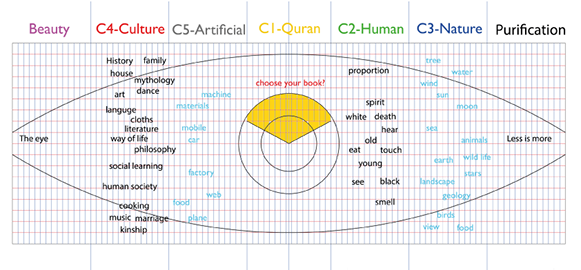
ADN is a one year course of design and professional practice, within a year students will have completed five minor projects and one major project, each of the minor projects examines one of the five principle categories of the school, literature, Human, Nature, Culture and Artificial, the process and result during those five projects will mostly be influenced by the varying aspects of Art, the final project will combine all the learnings acquired throughout the five previous assignments and apply them into a real life design project.
During the year students will be exposed to a wide variety of professional practice activities, those activities contribute to building the connection between what is learned within the classroom and how it is applied in the real world, these include site visits, they will witness firsthand how things are built and put together, how they come to life. students will also have the opportunity to learn from the industry’s experts, gaining academic knowledge as well as professional skills from guest speakers including architects, artists, engineers and contractors. They will also experience the office environment, professional meetings will be held on regular basis, students will attend lectures and learn how projects are delivered and implemented.
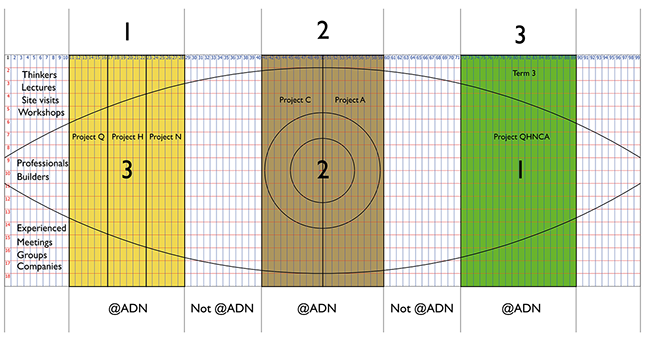
A Series of Projects
The course is implemented throughout a series of projects, integrating a unique design and learning techniques, the framework of which is developed entirely by Adn school of design. Each of those projects corresponds to a different aspect of reality considering the human, the product of the human and the natural environment.
The projects will be distributed throughout three terms, during the first term students will experiment with the three fundamental principles, literature, Human and Nature, after completing each principle’s final project they will have developed the skills necessary to progress into the second term where they will begin exploring and learning about the different aspects of art through examining the principles of culture and artificial, during the third and final term students will have the chance to further explore their options regarding the final project, the entire term will be dedicated to a real life design project.
Download Brochure