
Declaration
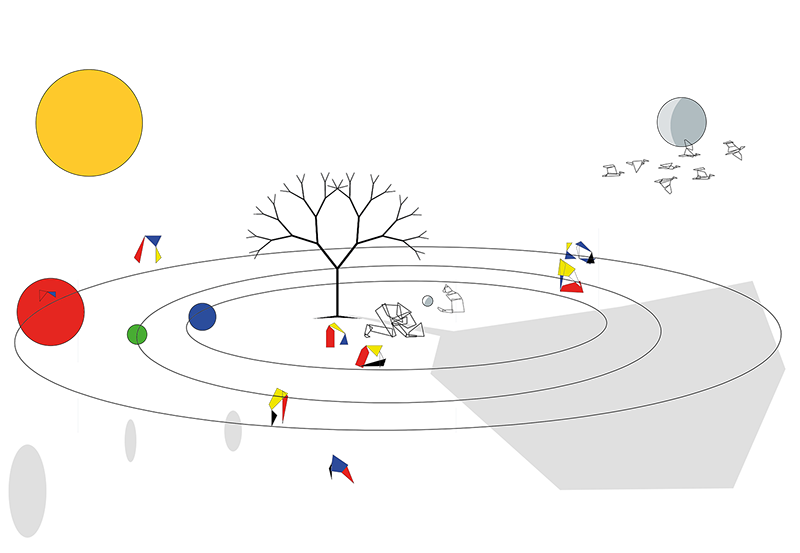
Religion is a subliminal knowledge concealed in humankind that embodies a safe haven, a vision of a harmonious future that surpasses physical existence, it gives humanity a higher purpose to enduring worldly hardships, and to appreciating contentment. Throughout history it influenced the conduct of different art forms, by its holy books, it casts a flow of poetic words forging an image of spaces and environments that have become the epitome of extraordinary compositions. The meanings contained in the books at times are interpreted as beyond the imagination of man, yet with the help of the very books, the mind’s aptitude for creativity is heightened, words of spiritual symbolism unveil a potential for ingenious creation that begins to manifest upon entering the realm of the unimaginable.
History had proven religion’s influence in artistic human expression, seen in an entire form of art; the Islamic art, seen in ancient paintings that express a world beyond ours, and even in renaissance architecture. Yet today religion is being continuously mispresented, used as a tool for oppression, when it ought to encourage unity and compassion between all the living, used to breed more conflict when it is intended to remedy and overcome destruction.
To return to the source, reclaiming the power of words as a formative instrument of culture, history and future, as it was before, to adhere to a time when knowledge is transmitted through storytelling, when poetry was the art of choice, devoid of superficial imagery, leaving the picture to be concluded by the imagination alone. reclaiming religion as a system that brings the benevolent human nature to the surface, to be a motive to spreading and communicating the meaning and the beauty of words in all its holy books. Litrature will be the source that stimulates and builds the vision of a new age, bridging a hopeful compassionate prospect, a creative vision, and lessons of the past together to forge a picture that extends at the very border of present understanding, narrating a portrayal of what the unimaginable could be. Thus, we approach creation as an internal process initiated by thought and developed by words to be later transformed to the external where the laws of nature and human conduct rule.
Philosophy of Adnism
Adnism is driven primarily by the three holy books that belong to the religions of the sky; Islam, Christianity, and Judaism. The school of thought examines the religious texts contained within each of those books, and attempts to reflect and compare them to creative poetry and literature. Adnism originated by extracting a detailed definition of the concept of heaven, how it is structured, its key characteristics, and the way in which heaven relates to man present in the physical world, it examines a methodology that consists of incorporating a fourth dimension “heaven” within the three dimensional world.
By understanding the book’s description of heaven word for word, evaluating the extracted knowledge through an individually driven thought process, and by understanding all aspects of the human being separately but simultaneously, application of the three key propositions; Heaven, Literature and Man is established. The designer ultimately constructs a link that connects all three together and eventually results in the term Adnism.
As mentioned above, the mechanism in which Adnism could be visually constructed within the physical world is founded upon three key propositions:
Adn (Heaven)
By extracting the literal meaning of the texts that define the concept of heaven and proceeding into producing works influenced entirely from that literal meaning, it is a design approach or a strategy that takes into account the spatial and environmental descriptions found in the religious texts, and turns them into works of art or architecture.
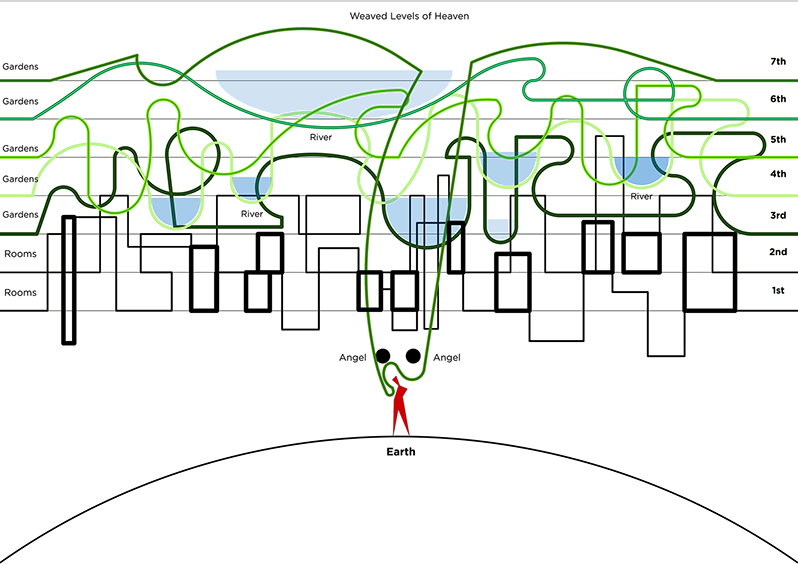
The Quran mentions heaven as being composed of seven levels, yet earth is not part of those levels as was depicted in other religions, the first level of heaven begins at the realm of stars and from there the first two levels of heaven are said to be “houses” i.e. rooms, while the five upper heavens are said to be gardens, each heaven has its own designated name that refers to its degree of rapture, (Abode of Peace, Abode of Glory, Garden of Refuge, Garden of Eternity, Garden of Eden, Garden of Bliss, Garden of Paradise), the first heaven is the dwelling place of stars and planets, the seventh heaven is a place of supreme bliss beyond the comprehension of the human mind, between each two main levels of heaven, is 100 years and 100 grades of heaven. The levels are referred to as being both superimposed and weaved together, this elaborates the notion mentioned in the Quran that states, while humans exist below the first level of heaven, the angels on their shoulder exist on the seventh level. Therefore, with the layers interwoven together parts of the seventh level could partially exist on different other levels as well, and vice versa.
The Quran depicts the gates to heaven as appearing according to the person’s order of worship to god, there is eight gates allowing an entryway to heaven; for prayer, fighting for god, charity, pilgrimage, faith, remembrance of god, fasting and suppressing malevolence. The seventh heaven is said to be the origin from which four rivers flow to and under the gardens of the remaining levels of heaven, the four rivers are identified by their substance, of water, milk, wine and honey. The banks bordering the river of water is said to be covered with tents of hollow pearls.
The Islamic heaven is depicted as a place for socializing, and reuniting with lost family members, the Quran emphasizes on a heaven that contains all types of vegetation particularly grape vines, the gardens are said to contain large trees that provide shade to seats arranged in ranks, where dwellers of heaven sit facing each other, and forming interactions with one another, also heaven is said to contain earthly and heavenly people, heavenly children are said to roam around those seats and provide nourishment to earthly people.
Heaven in islam
Download Document

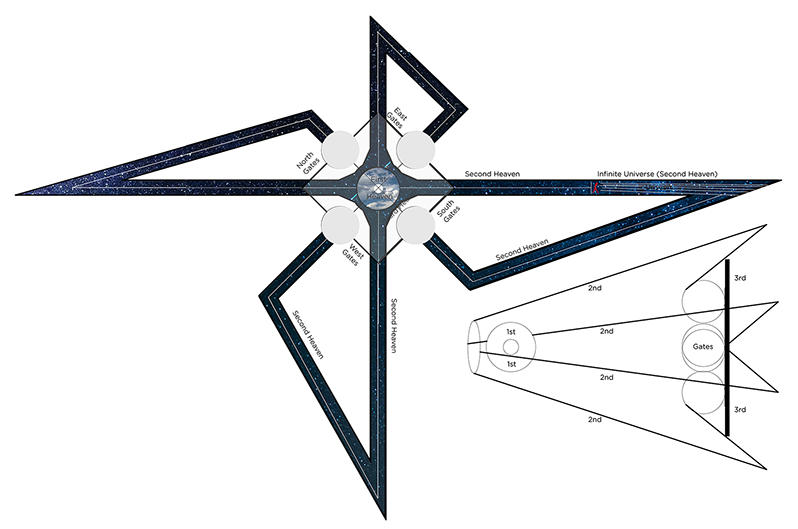
The bible refers to three heavens above earth, the first is visible to us, where the birds and clouds dwell, the second extends as far as humans can see, it is the dwelling place of stars and planets, and the third is invisible to humans, just beyond the vanishing point of the second heaven, where god’s throne is, where angels are, and where the righteous end up when they leave earth. To decipher the shape of the second heaven we must link it to the familiar characteristics of space, we know that the bending of space gives us a vanishing point which in turn gives an illusion of an infinitely continuous space, we can thus assume that the second heaven is composed of two forms the initial one imitates the first heaven and from it the heaven extends in tendrils that acutely bend just before they connect with the gates of the third heaven. The third heaven is described as a square city bounded by tremendously thick walls, containing three gates at each cardinal direction, the bible describes the gates as pearls, thus are spherically shaped, this necessitates the assumption that the gates roll open through specified tracks, perhaps to be rolled by the angels that guard them. The 61-meter thickness of the walls indicates that whomever enters the city would have to go through a fairly long corridor, which brings to mind the rolling track, perhaps the entrances to the third heaven is through sloped corridors that extend as the pearly sphere gates roll ahead of the visitor. There is emphasis on the materials of heaven, the wall of the city is said to have twelve foundations, each decorated with a particular type of precious stone, whereas the wall is made of jasper; a reddish colored stone, and the city of pure gold, the bible refers to a great street, a vast one that is extremely pure and is made of gold.
There is no sun and no moon, the brilliance of god is heaven’s light and the lamb of god (an image of Christ) is heaven’s lamp, thus it could be said that the source of its light within enclosed spaces is the lamb, god’s throne is within the center of the city, at a higher point, reached through a staircase and across a doorway, the throne of god is said to be at the center appearing like jasper and carnelian, surrounded by an emerald looking rainbow, around god’s throne is twenty-four thrones occupied by people dressed in white garment, the circle is said to be electrified and fueling seven torches of fire.
The bible heaven is a place to see god, and to exist as fellows to god, the bible depicts heaven as a place to work in pursuit of unification with god through worship and never-ending spiritual progress, worship of god is carried out through work and creative pursuits, dwellers of heaven creatively work to pertain their place together and achieve unity with god.
Heaven in Christianity
Download Document
Heaven in Judaism
Download Document
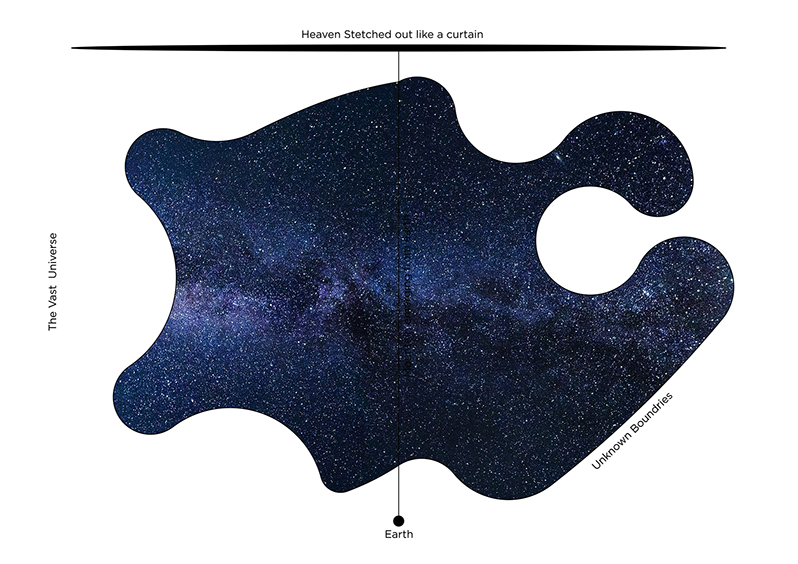
According to the manuscript’s descriptions, the heaven is part of a larger composition, that compromises earth as well, it is characterized by being within the higher realms of the universe hence the notion of it being a reward that requires effort, be it physical or mental to reach its dimensions. Despite the Torah’s portrayal of heaven’s singularity It certainly hints to an arrangement of some sort that divides it into ten regions with the seventh being the highest, this prompts the question of the type of order that would identify each region according to the manuscript’s count, a typical multi-leveled structure would suggest the tenth level being that highest, however this application is untrue in this case, this could indicate that regions are neither layered; above one another, nor are they flat. Similar to the behavior of stretched fabric to reference the (curtain or tent), they are rather an angled extension of spaces that both parallelize and intersect at different points. The floor of heaven is carried out on the mountains of earth, resembling the structural column, they extend beyond the universe to support the heavenly realm. The firmament; a domed structure, is said to be a support to a realm where the sun, moon and stars reside, thus carrying the initial region of heaven, furthermore it is said to be dividing the waters of heaven from that of the earth, withholding the upper waters from mixing with the lower, this hints that the initial region of heaven is in fact made of heavenly water and carried on the firmament that which by enclosing the entirety of earth, serves to prevent the heavenly waters from entering the realm of earth. The Torah refers to a mechanism that explains earth’s supply of water, and its conversion to other forms such as snow and hail, it reveals the existence of heavenly storehouses within the initial regions of heaven, the storehouses contain water and below them are windows or openings, that allow the water to pour down on earth, given that climatic conditions vary on different parts of earth, it suggests the division of the openings is composed in accordance to the regional divisions of earth.
It is said that the heavens do not contain god but rather the opposite, while also the Torah manuscript indicates that god is within the highest reach of heaven, thus it could be stated that the prominence of god’s place (throne) is located within the highest regions of heaven, however it extends to encircle the entire composition of spatial existence, this includes earth, the universe and heaven, to comply to the idea that god contains all, similarly a multitude of perpendicularly placed orbits, encircle the projectile of god, the orbits represent the angelic, astral beings which are made of light.
Torah states that heaven is an academy, thus a place for learning and acquiring knowledge, for a place to sustain and deliver knowledge, it must contain objects such as books, or through people such as in lectures and meetings or through mechanisms that spark curiosity, knowledge is a flow of information transmitted from object, person and place.
Man
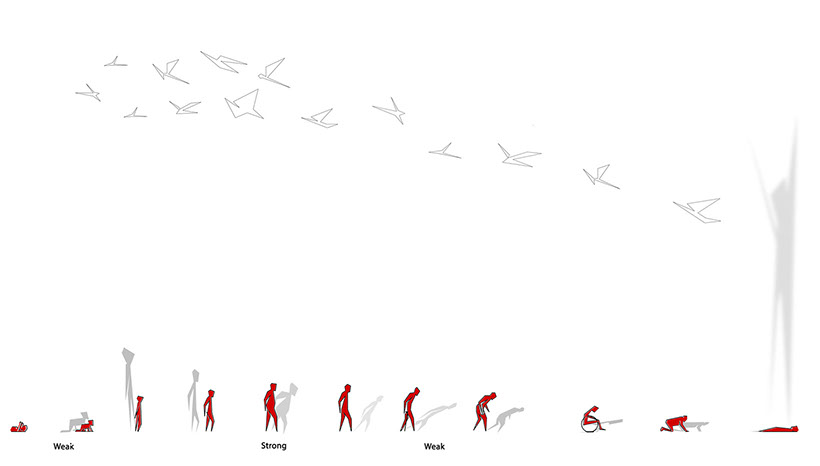
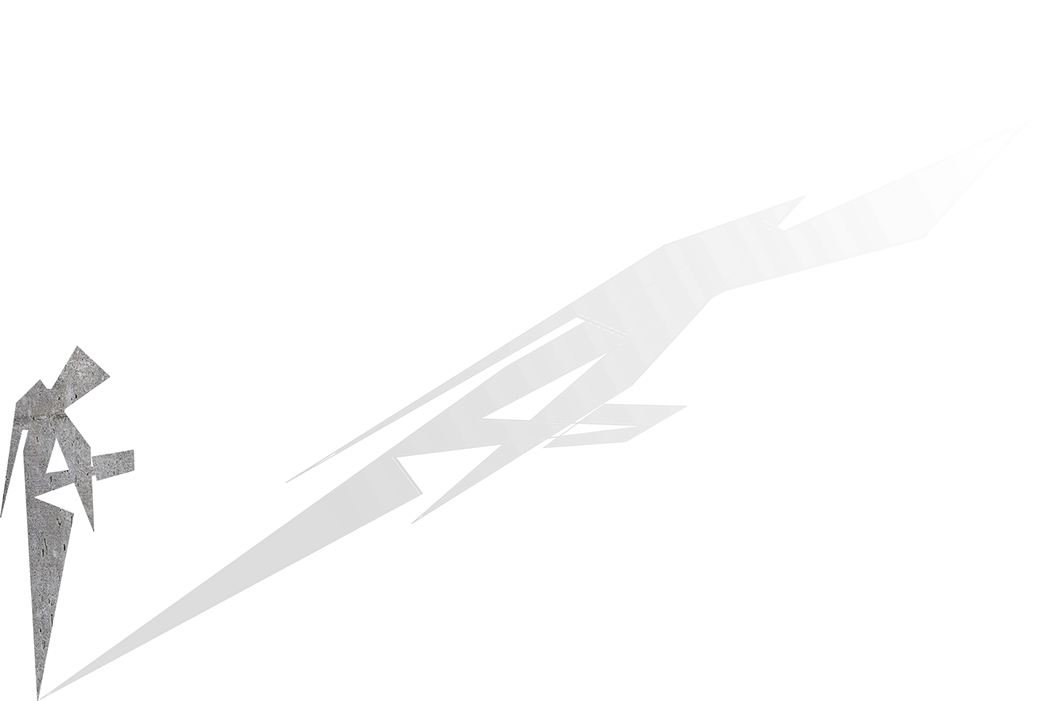
The stories found within the pages of the holy Books, shows examples of human behavior, of the choices that are made and the consequences that happen, this allows for a clear understanding of the ways to deal with the human being and the ways in which man interacts with the surrounding environment, the Quran exists solely for the human being, it contains clear instructions of the ways in which the human should behave, of the choices that should be made to transcend to heaven, those instructions will be brought forth to the attention of the artist and the designer and will be utilized as a principle to progress the design of a creative environment.
Litrature
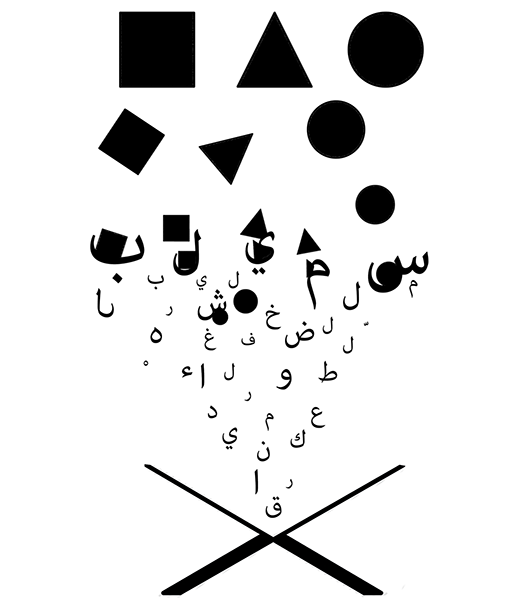
The philosophy behind using Litrature, is to extract the creativity that lies dormant within words, whether it is Shakespeare or the Quran. Adnism employs the world’s reservoir of multilingual litrature to create individual works of art and design. Through a systematic process that gradually transcends to a metaphorical conclusion. Words are interpreted and portrayed in art and architecture according to the creator’s imagination and intended trajectory.
STAGE 1 THE SOURCE
The design birth process begins with the selection of three Quranic verses, the selection criteria is subject to the student’s life experience and intellectual curiosity, further on the study aside from the philosophy each verse will determine the type, location and purpose of the design or artwork, next the verses are interpreted in a literal sense using the official books of interpretation for the holy book of Quran, the subject matter of the interpretations is further explored through quick abstract drawings and sketches.
STAGE 2 PERSONAL
The three verses are then interpreted in terms of the student’s individual understanding, the verse is broken down and examined beyond its actual meaning, each word is viewed in terms of the circumstances that led to the holistic underlying meaning and purpose, and the ways in which the student relates to it, as they begin to personalize the meaning to how they individually see it, they correspondingly start to compose a body of text that outlines their individual comprehension and next they proceed to summarizing the text into relevant phrases and engaging words, conclusion sketches accompany all written text.
STAGE 3 THE SEARCH
The students proceed to link their developing philosophy to existing works of art, by using their previously outlined words as guidelines or directional clues, the students conduct a search to find and interpret artwork (Installations, paintings and sculptures) according to their own philosophical stance, furthermore for a clearer demonstration of the link, the students are encouraged to illustrate their thoughts in quick sketches and written descriptions.
STAGE 4 CONCENTRATION
The students start to project their thoughts into reality, they perceive the three dimensional surrounding setting in close connection to their philosophy, evolving from abstract ideas to the tangible means of composition, shade/light and materials, this stage is carried out by capturing images, the students manipulate their surroundings to reflect their philosophy by creating compositions that vary in visual quality or they attempt to speculate what is right in front of them by finding and capturing the untouched and intricate details of nature and man-made objects that they judge it to be an ideal reflection of their philosophy.
STAGE 5 CONCLUSION
To conclude their thoughts on the subjects of the verse, their individual understanding and their developed philosophy, the students proceed into producing three final drawings in the form of collages, paintings or clear sketches accompanied with a coherent body of text that describes the drawings and the concluding idea, this stage should ultimately result into the formulation of a design topic.
STAGE 6 BRIEF
The brief consists of an introduction outlining the definition, purpose and the location of the design or artwork and a comprehensive study of the aspects and limits that the student decides is a key influence to the topic, the study is outlined and illustrated as analogue to the previously composed philosophy.
STAGE 7 MACHINE
This stage is a brief diversion from the former study, to prepare the students for the complex outputs that result from the interaction of human, object and space, they choose to conduct a study of the human proportions, behaviors or movements and their effect on objects and the dynamics within spaces, the students are divided into groups consisting of 2-3 individuals, the path they choose should closely relate to their intended design topic.
STAGE 8 REALITY
This stage is divided into two parts the first part is concerned with the practical application of the previously formed philosophy in accordance to the chosen topic, while the second part is defined by the logical development of the design concept through the use of standard references and case studies, the student concludes with initial draft drawings that combine all of the knowledge gained from the previous stages along with brief descriptions.
STAGE 9 LIFE
The students finalize their drafts of the preliminary drawings, the choice of drawing is determined by the students and what they judge it to be the best representation of their design for instance they are expected to develop perspective views, diagrams and/or technical drawings such as sections, plans and elevations.