Design that Educates Ideas Competition
Download Document
We learn by interacting with the world outside ourselves, we depend on our eyes, ears, touch, smell, physical body and spirit to exist in a constant state of awareness that allows us to gather and synthesize information effortlessly. We consciously and unconsciously capture all that corresponds with us throughout our existence. The merging of our senses and the physical realm breeds a perceivable reality, a life. Our consciousness is connected to a database and is awakened the second we are born enabling us throughout life to capture and conjure information from our minds, link it to our surroundings to rationalize or create our experiences. Throughout our existence we have ingrained certain visual qualities within our subconscious mind that we continuously resort to as a clue or a connection to identify the unfamiliar images that we encounter. At times we create a visual link that aside from the physical qualities is entirely irrelevant to the object in question, however we find that image to be relevant because it matches a deep embedded impression, we've become accustomed to and have observed it regularly throughout life.
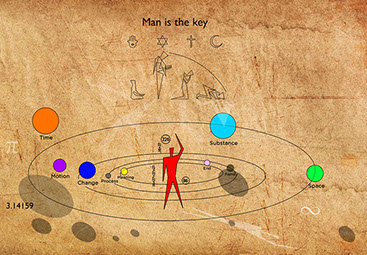
There is profound potential for the untrained mind to detect design decisions without any prior knowledge of the purposes that perhaps have led to a particular form or function. Through the deliberate expression of the problem, the design can tap into the subconscious mind of the observer, bringing forth information stored from the earliest years and experiences of the observer, knowledge that is inherent and identical in each and every individual, the human’s need for order and shelter such as the understanding of material, and the perception of space and object, or the need for belonging through forming ties with other individuals. This intuitive knowledge will be key to establishing an intellectual connection between the mere physical object and the depth of understanding that the mind conceive of it.
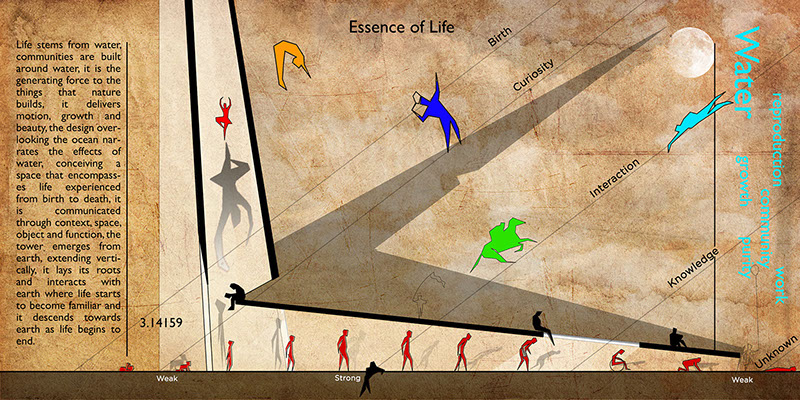
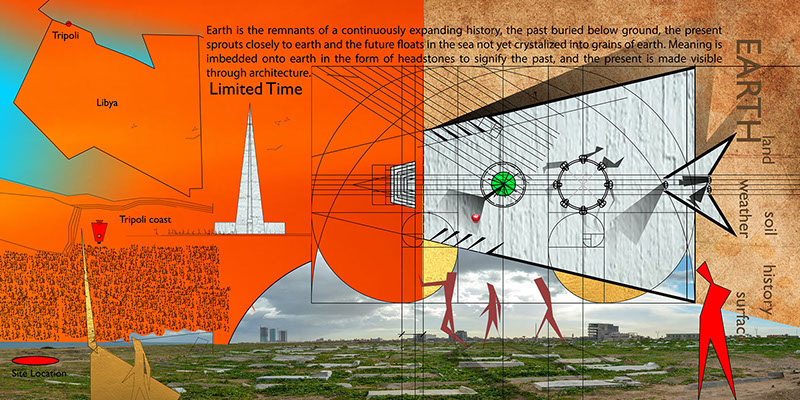
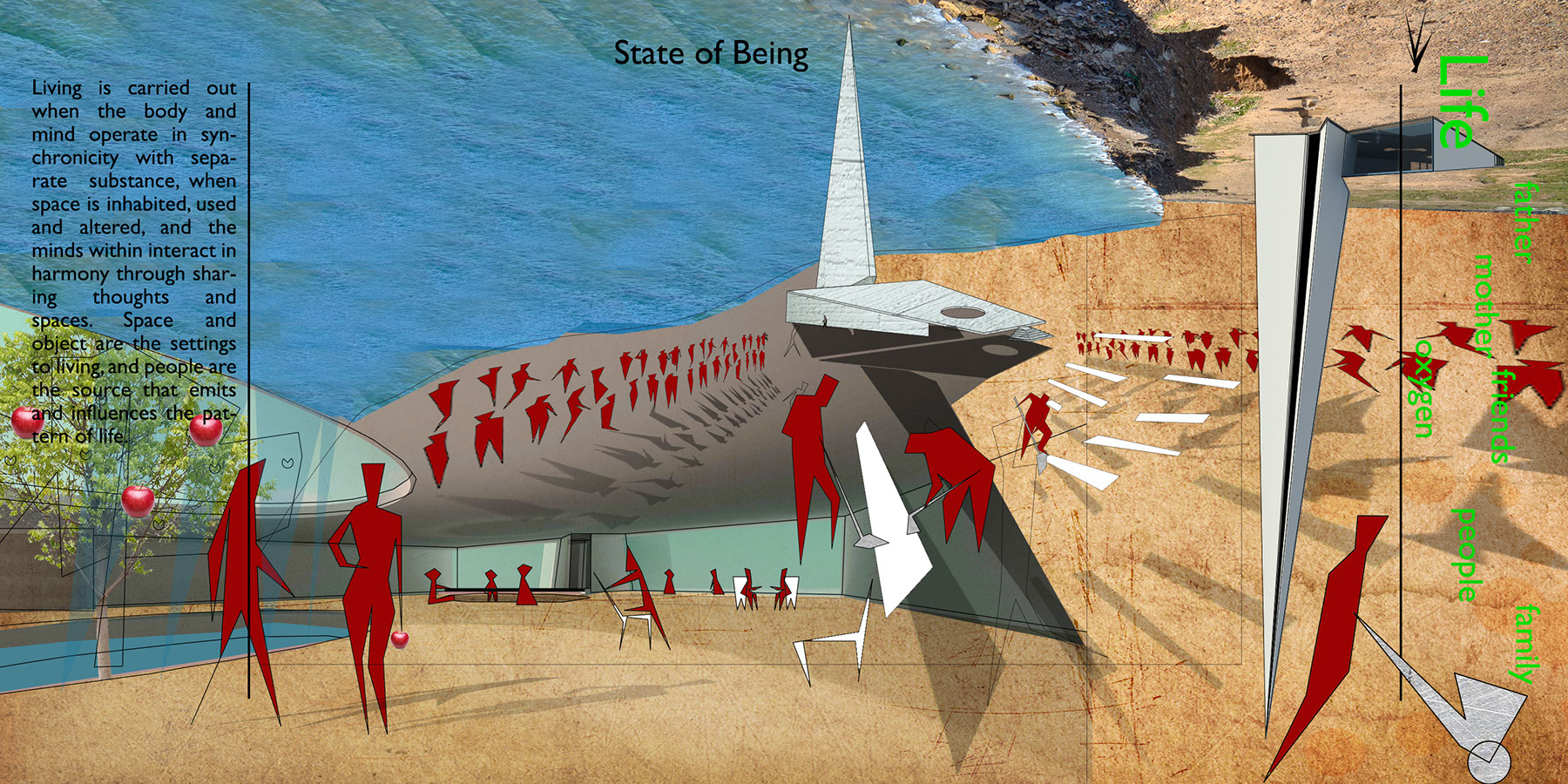
The design of the problem in harmony with the solution is the stimulant that will provoke an active questioning and reasoning approach by the user. The design will manifest the underlying idea through direct and paradoxical means, acting as a mediator between the conscious and the subconscious mind of the observer. Beginning with the overall form, the vertical soars high and the horizontal meets it at the base, the mind will dissect and question those slender forms, curiosity is at work, the problem imposed is the proportional equilibrium of those forms, the eye will detect the solution in that single point of intersection between the two. The space is positioned within a context of two extremes, the sea articulating a timeless permanency and the grave conveying the ultimate truth; that all is temporary, the space is bounded by the two and functioning as a double ended viewing lens, the upright directed towards the sea and signifying strength, and the fallen directed towards the grave conveying weakness. Whereas the information within is communicated through a metaphorical narrative of birth, conflict and peace, attempting to direct the awareness to the experience and the outcome of such change, forming a radial trajectory between the contradicting aspects of tranquility and conflict.
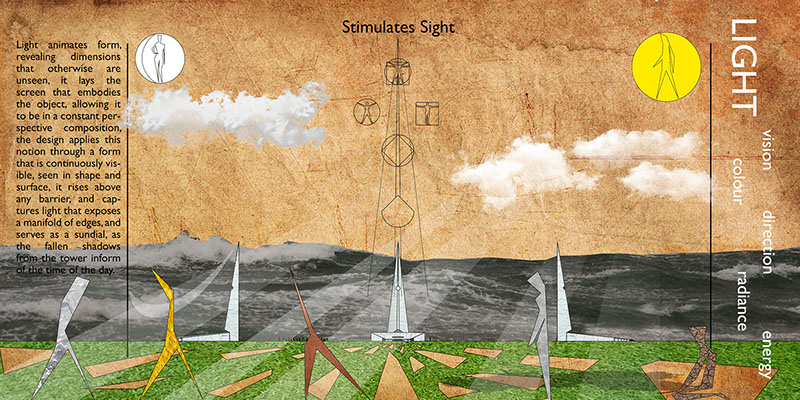
The building is marked by a soaring tower that the eye sees from a distance and is the cover that will spark the curiosity of those who observe it. As the body enters the space through the tower that which at 40.5 meters, surpasses the scale of the observer by large, diminishing the sense of power within the heart, bringing forth long-forgotten childhood perception of space. By altering the mindset, it forges an instrument of reflection that draws up the forthcoming dialogue between the user and the design. Moving to a closely bounded space that extends towards a scenery that signifies mortality, it maintains a unified fixed seating etched from the ground up for information to be gathered from other minds, in an arrangement that demands physical interaction with architecture and mental interaction to solve conflicts with others, the fixed seating towards the sea suggests individual contemplation, while the scattered adjustable seats spread within the space proposes a choice, of aligning towards the grave, sea, or other people, the space is lidded by a sloping, punctured roof, emphasizing the importance of shelter through conveying the results of its absence, allowing climate factors to affect the space, each design element performs and fails to perform its function simultaneously. The design thus facilitates learning through the eccentric quality found in the experience and appearance of the space.
“You know, it is life that is right and the architect who is wrong”
Le Corbusier